The Growth of Vocational Pathways in Senior Phase
Scottish secondary education has undergone a major positive transformation over the last decade. Senior Phase (S4–S6) timetables are no longer restricted solely to traditional SQA National 5, Higher, and Advanced Higher exam courses.
Today, schools offer a rich variety of SQA vocational pathways, including:
- National Progression Awards (NPAs): Specialised vocational courses in Cyber Security, Bakery, Barista Skills, Enterprise, and Games Development.
- National Certificates (NCs) & Skills for Work (SfW): Practical qualifications covering Early Learning & Childcare, Automotive, Construction, and Hospitality.
- Foundation Apprenticeships (FAs): Work-based learning qualifications delivered in partnership with local colleges and employers.
Understanding Vocational & Modular Assessment Structures
Many vocational and modular qualifications do not produce a single A to D working grade. Progress may instead depend on completion of units, portfolios, practical evidence, workplace components or other qualification-specific requirements. Schools should therefore use tracking indicators that reflect the structure of each award rather than applying one generic grade model.
Skills for Work courses, for example, are generally assessed on a pass/fail basis, while Foundation Apprenticeships combine multiple qualification and work-based components.
Key considerations for tracking non-graded qualifications:
- • Defined Evidence Requirements: Many NPAs and NCs are built from units assessed against defined evidence requirements rather than a single A to D course grade. Schools should check the specification for each qualification before designing tracking fields.
- • Avoiding Forced Dummy Grades: When forced to pick a grade in rigid traditional systems, teachers often enter arbitrary placeholder grades (e.g. "Pass" entered as "A" or "N/A"), creating confusion for SLT and parents.
- • Clear Parent Reporting: Using tailored Course Status indicators ensures parents understand pupil progress without seeing misleading blank columns or artificial grades.
The Solution: Tracking Progress via Course Status
In Smart School Tracking, schools are not forced to assign working grades to non-exam courses. Instead, teachers record progress using flexible, customisable Course Status indicators.
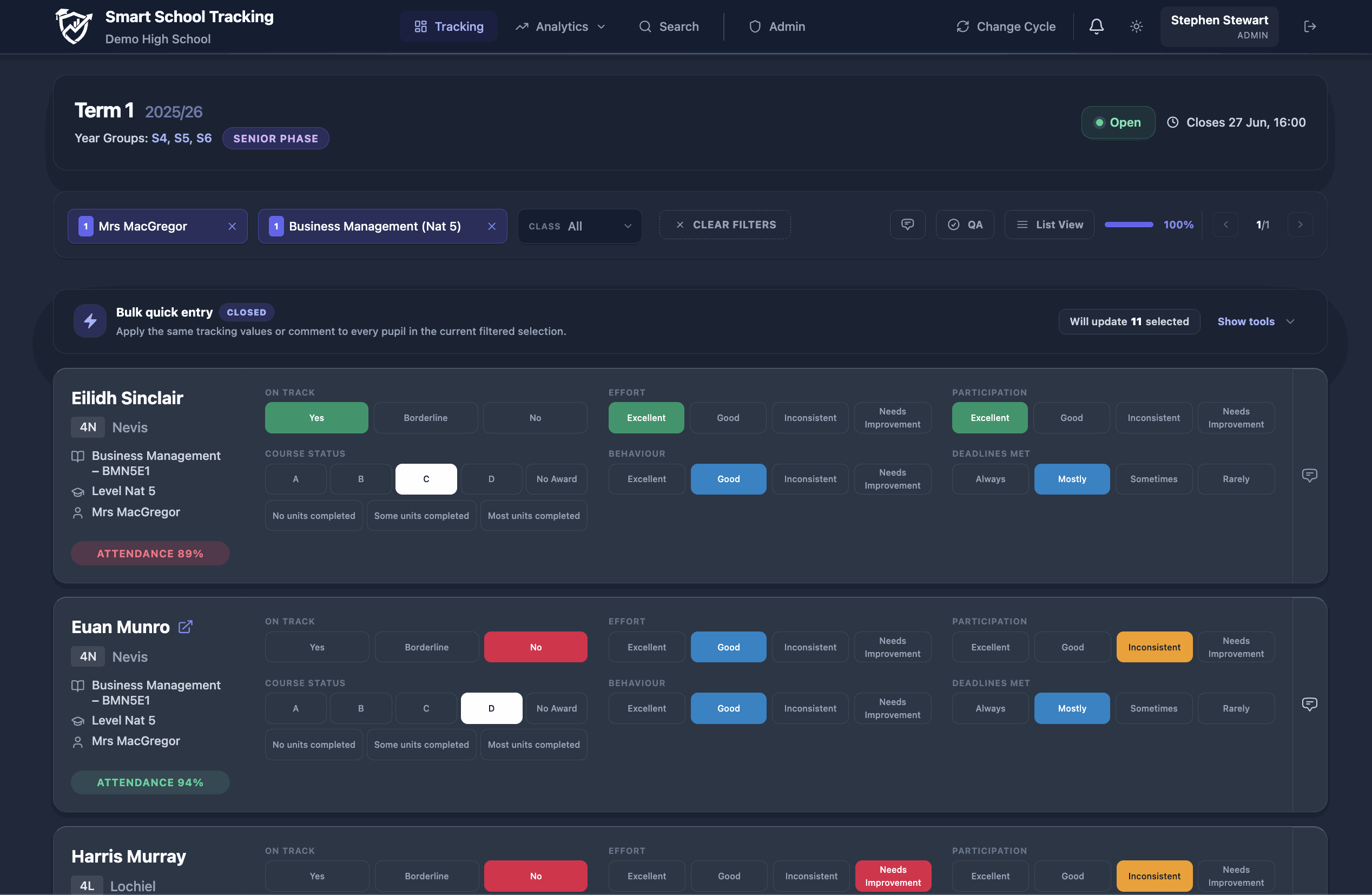
Example Course Status Indicators:
- On Track for Full Award (All units progressing)
- 3 of 4 Units Completed
- Needs Unit Resit / Portfolio Catch-up
- Single Unit Only Presentation
Benefits for Teachers:
- Complete class entries in seconds
- No awkward letter grade conversions
- Instant a single click bulk updates
Better Parent Reports & Accurate SLT Insight
By separating exam-based working grades from vocational Course Status, Scottish schools achieve clarity at every level:
Clear Parent Reports
When parent reports are generated via Smart School Reporting Software, vocational courses display clear status statements (e.g., *"Complete — On Track for Award"*) rather than misleading blank boxes.
Accurate Whole-School & Department Analytics
On the school analytics dashboard, vocational awards are calculated alongside traditional qualifications without distorting academic grade averages.
Flexible tracking for every course in your school
Discover how Smart School Tracking handles National 5, Higher, NPAs, NCs, and BGE levels in one simple platform designed for Scottish secondary schools.